
Welding Machine Repair, Maintenance & Support Services
Every day your butt welder sits idle is a day your production line isn’t moving. Micro-Weld provides expert welding equipment repair, preventive maintenance, and hands-on training — in-plant or remotely.
Your welding equipment expert – from installation to repair
When you need welding machine repair, the last thing you want is a generalist with a multimeter and a parts catalog. Micro-Weld technicians know resistance welding — and specifically, butt welding — from the ground up.
Our welding repair service goes beyond a quick fix. We’re the team that built your machine, which means we understand every component, every wear pattern, and every failure point.
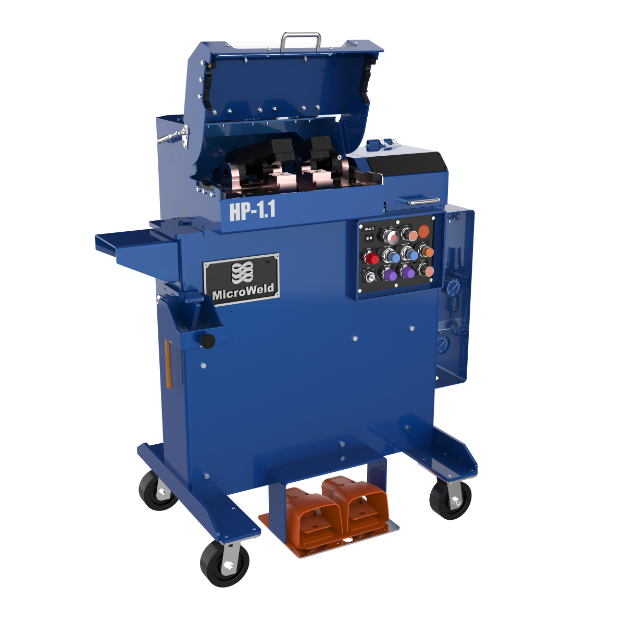
From the moment your equipment arrives to the day it needs its first scheduled service, we’re your maintenance department expanded.
Rule of thumb: if you’re asking whether you need service, you probably do. A 30-minute call with our team costs nothing and can save thousands in emergency repair costs.
Welding Machine Services
End-to-end support for your butt welder — from the day it’s installed to its annual maintenance check.
In-Plant Installation & Commissioning
Our technicians arrive on-site to customize machine settings for your specific wire gauge, material type, and production volume — then walk your operators through the controls before running a single weld.
Welding Machine Repair & Preventive Maintenance
Proactive welding machine maintenance is the most cost-effective investment a plant team can make. We offer scheduled PM programs and on-demand repair — in-person or remote.
Documentation and maintenance reporting
- Scheduled preventive maintenance visits
- Remote and on-site equipment repair
- Post-repair performance verification
Training
Turnover, new equipment, and process changes create gaps in institutional knowledge. Micro-Weld training programs are built around your machines, your settings, and your team.
- In-person and virtual delivery
- New equipment operator onboarding
- Maintenance team technical training
Why Equipment Owners Choose Us For Service
When you need welding equipment repair, you get technicians who know your welder as well as you do.
We Built Your Welder
Our service team works on the same machines our engineers designed — faster diagnosis and fewer misdiagnosed repairs.
Genuine Micro-Weld parts
Third-party components may fit, but they rarely perform the same. Genuine parts restore your machine to original spec.
We Document Everything
Every service visit includes a written summary of work performed, parts replaced, and recommended next steps.
We work Around Your Schedule
Flexible scheduling for preventive maintenance visits, and priority response for emergency repair calls.
Parts, Ceramics & Upgrades
Everything you need to keep your butt welder running at peak performance.
Replacement Parts
Genuine Micro-Weld replacement parts designed specifically for your butt welder — so they fit right, perform right, and last longer than aftermarket alternatives.
Welding Ceramics
Ceramic sleeves that provide consistent, firm hold across stranded wire and cable — eliminating the uneven gripping and weld defects that come with improvised alternatives.
Machine Upgrades
Add finger-safe guarding, solid-state heat control, interlock switches, and emergency stop systems. Get the performance and compliance of new equipment without the capital expense.
Signs Your Equipment Needs Service
Knowing when to act can prevent a minor issue from becoming a full production stoppage.
Inconsistent weld quality
Weld breaks, irregular upset formation, or inconsistent burn-off are early signs of electrode wear or electrical component degradation.
Increased cycle times
If your machine is taking noticeably longer between welds, a worn component or calibration drift may be affecting heat control or the upsetting sequence.
Unusual sounds or vibration
Mechanical noise during operation typically indicates a wear issue that worsens without intervention.
Safety feature anomalies
If interlocks, guarding, or foot pedal controls behave unexpectedly, stop operating the machine and contact our repair team immediately.
It’s been over 12 months since your last service
Even high-performing machines benefit from annual welding equipment maintenance — lubrication, electrode inspection, and pressure calibration.
What Our Clients Are Saying

Recently, Adam Fore came to the Okonite Orangeburg South Carolina plant to help us PM several welders and to provide a review and critique of our welding practices. Adam is a very competent and knowledgeable welding expert. Adam guided us through the PM process, and we got several welders back in tip top shape. He was generally pleased with how we were setting up our welders which was a relief. He also provided some additional very helpful pointers and recommendations, some of which we have implemented and some we are planning to implement. Adams visit was well worth the money. We hope Micro Weld is planning to hire and train one or two more competent and professional technicians, trained by Adam, to take the reins when he retires!
Mike St Jean | Process Engineer at The Okonite Company
Frequently Asked Questions
Welding machine maintenance is scheduled, proactive work done before a failure occurs. Welding machine repair is reactive — your machine has already stopped performing correctly. Most emergency repairs we see could have been prevented with regular maintenance. Our team can assess your equipment’s current condition and recommend the right service level.
Both. We offer in-plant visits for hands-on welding equipment repair and preventive maintenance — our technicians come to your facility and perform service on-site. For less complex issues, we also offer guided remote support where your maintenance team performs the work with our technician walking them through each step live.
For remote support, we can often connect with your team the same day. For on-site visits, we work to schedule as quickly as possible. Contact us directly at (630) 406-9550 for urgent repair needs.
A standard visit covers: electrode and electrode holder inspection, mechanical lubrication and alignment check, electrical system inspection, heat control calibration, pressure system verification, safety feature testing (interlocks, guarding, foot pedals), and a written service summary with recommended follow-up actions.