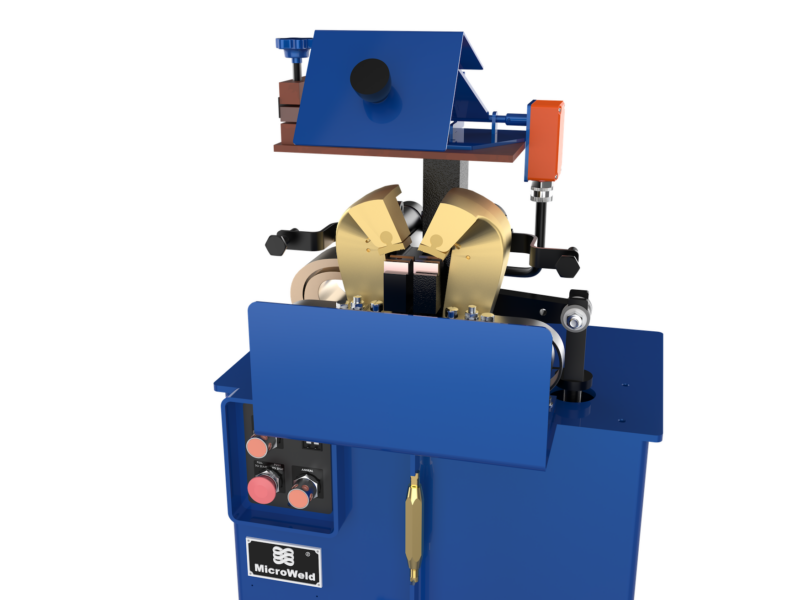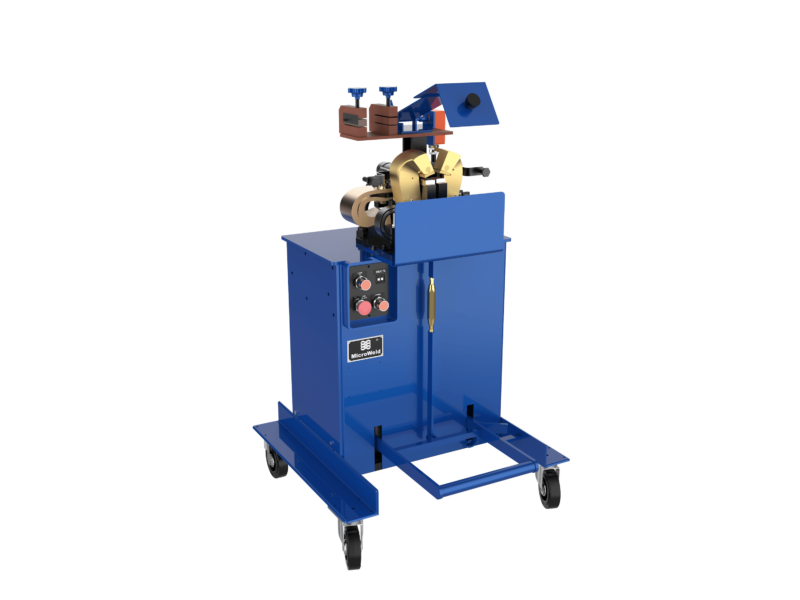
J4SF
Steel Strip, Titanium
View Product

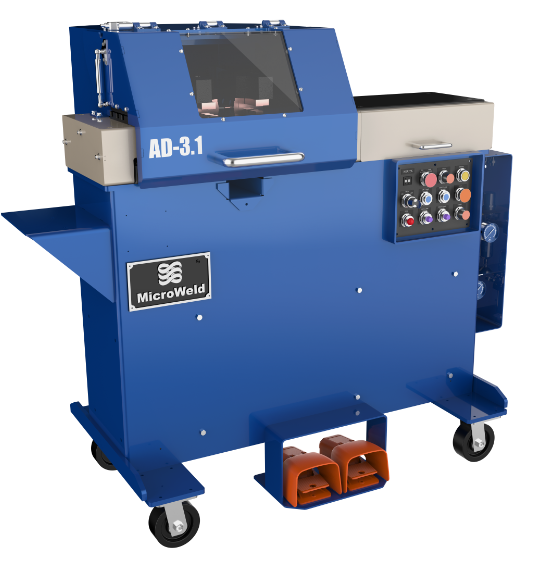
Micro Weld provides robust, production-ready solutions with application-specific tooling, durable construction, operator training, and flexible configurations. Ideal for applications demanding tight tolerances, minimal scrap, and high repeatability, Micro Weld’s flat welders uphold quality and efficiency in demanding production settings.
Ring construction is used when circular geometry, uniform alignment, and consistent weld integrity directly impact final part performance. Ring welders are engineered for closed-loop and circular applications where maintaining roundness and dimensional accuracy is critical. Controlled clamping and heat input ensure seamless joints that preserve ring geometry through coating, plating, or secondary assembly. This construction type is best suited for high-volume production of hoops, wire rings, frames, and specialty circular components that require repeatable weld quality and minimal distortion.
Flat welding is used in applications where strip, sheet, or flat wire must be joined with precise alignment, minimal upset, and consistent weld geometry. Flat butt welders are engineered to maintain cross-section integrity so welded material feeds cleanly into downstream processes.
Common flat welding applications include:
These applications require stable clamping, uniform heat delivery, and controlled upset to prevent distortion and downstream handling issues.
Flat welders are used in manufacturing environments where material geometry, repeatability, and surface consistency directly impact product quality and process efficiency.
Typical industries and production settings include:
In these environments, flat welding machines must deliver repeatable welds that pass smoothly through downstream equipment without introducing distortion or variation.
Flat welding machines are commonly used for strip stock, sheet metal, and flat wire made from steel, stainless steel, copper, aluminum, and other compatible alloys.
Flat butt welding requires precise edge alignment and controlled heat input to maintain flatness and consistent cross-section, which is critical for downstream forming or stamping operations.
Yes. Flat welding machines are designed for high-cycle production environments where repeatability, low scrap rates, and uptime are essential.
Flat welders can be configured to integrate with existing payoff, take-up, and downstream forming or processing equipment.
Properly executed flat welds maintain uniform thickness and alignment, allowing welded material to pass through forming or stamping processes without tool damage or material failure.
Micro-Weld combines application-specific tooling, durable machine design, and long-term service support to help manufacturers achieve consistent flat weld quality with minimal production disruption.
At Micro Weld, we pride ourselves on our dedicated customer care and support team. Our team is always ready to listen to your needs and work in partnership with you to develop the right solution for your team!